
Most restaurant window decoration ideas you find online are about props — fairy lights, plants, chalkboards, seasonal wreaths. That’s the easy part. The harder question is which decor actually stops pedestrians and which just fills the glass. Two restaurants on the same street, with similar menus and similar prices, can have wildly different foot traffic — and the difference is almost never in the kitchen. It’s in the window. This guide breaks down the seven types of decor that working restaurant windows are built from, the psychology behind why each one works, and how to combine them so that your storefront turns passersby into paying guests.

The Three-Second Window: How the Pedestrian Brain Decides
The human brain processes visual information in nanoseconds. Long before a pedestrian consciously thinks about lunch, their visual cortex has already scanned your storefront, classified it, and made a preliminary decision: walk on, slow down, or stop. Retail researchers consistently put this window at one to three seconds. That’s all you have. Everything else — your reviews, your menu, your interior — only matters if the brain decides to give you those first three seconds of attention.
This is why restaurant window decoration ideas are not a question of taste or aesthetics. They are a question of engineering. A working window display acts as a silent salesperson, communicating cuisine, price range, atmosphere, and quality before a single word is exchanged. Restaurants that understand this design their windows around how the brain actually works, not around how owners hope it works.
Why “Empty” Windows Lose Money Even with a Great Menu
An empty or sparsely decorated window sends a signal the owner never intended. The brain reads emptiness as absence of value. The pedestrian doesn’t think “this restaurant has a minimalist aesthetic” — they think “there’s nothing here for me,” or worse, “this place is overpriced and intimidating.” Even when the menu inside is excellent, an underdressed window creates a barrier between the street and the door.

The opposite is also true. A window dense with appetizing food samples and thoughtful decor reads as abundance, success, and confidence. This is social proof applied to architecture: if the restaurant is willing to invest in showing off what it serves, it’s likely worth walking in. A well-designed restaurant window display design is not just decoration — it’s a credibility signal that justifies the price on the menu before the guest ever sees it.
Seven Types of Restaurant Window Decor: A Working Vocabulary
Before we look at how decor influences the pedestrian brain, it helps to know what kinds of decor we’re actually talking about. Restaurant decor isn’t one category — it’s seven, and most working windows combine three or four at the same time. Owners who can name each type can also plan rotation, budget, and visual hierarchy with much more precision.
1. Seasonal decor. Tied to the calendar season — cherry blossoms in spring, palm leaves and sunflowers in summer, maple leaves and pumpkins in autumn, pine and snow in winter. The strongest tool against pedestrian habituation.
2. Holiday and event decor. Tied to specific dates — Christmas, New Year, Halloween, Valentine’s Day, Easter, Mother’s Day, Father’s Day, Thanksgiving, local national holidays. Creates urgency the way “limited time” creates urgency in advertising.
3. Thematic and lifestyle decor. Reflects the concept of the venue regardless of the calendar. Each cuisine and each format has its own visual vocabulary:
- Airport restaurant: model aircraft, globes, country flags, departure-board graphics, vintage travel posters.
- Japanese restaurant or sushi bar: paper chōchin lanterns, folding fans, kokeshi dolls, ukiyo-e prints, bamboo, noren curtains. For more examples of how thematic props combine with food replicas, see our Asian cuisine displays gallery.
- Italian pizzeria: vintage Italian road signs, string lights, straw-wrapped Chianti bottles, checkered fabrics, wooden pizza paddles.
- Seafood or fish restaurant: ropes, fishing nets, ship wheels, lighthouse lanterns, glass floats, driftwood.
- American diner or retro cafe: chrome trim, jukeboxes, vinyl records, neon signs, Coca-Cola memorabilia.
- Tropical cafe or tiki bar: palm leaves, seashells, bamboo, Hawaiian leis, rattan furniture.
- Industrial loft or craft beer pub: exposed metal, raw wood, brick, Edison bulbs, beer barrels.
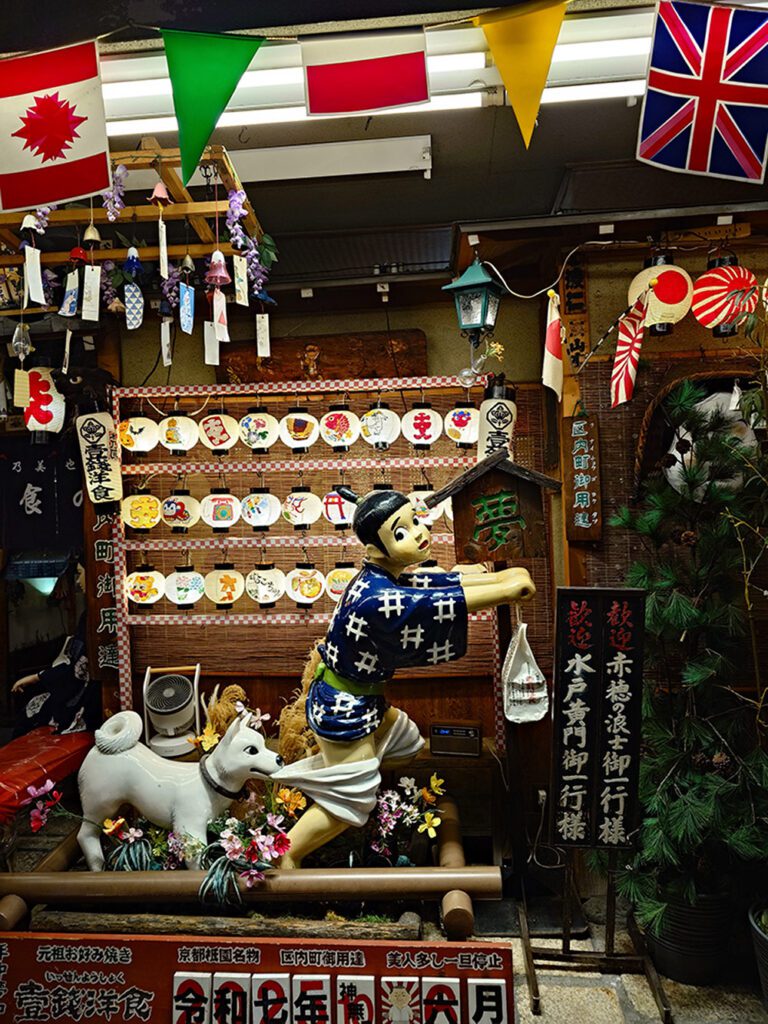
- Edo-period Japanese cafe: wooden signage, noren curtains, hanging lanterns, festival flags, hand-painted boards.
4. Branded and co-branded decor. Uses recognizable characters, logos, or brand collaborations — house mascots, licensed figures, partnerships with other brands. Adds emotional resonance and recognition.
5. Promotional decor. Highlights a specific offer, new dish, or limited edition — price tags, “new” tags, posters of dishes, POP materials. Converts attention into a concrete choice.
6. Architectural and compositional decor. Decor that becomes a sculptural element in itself — towers, pyramids, garlands, vertical walls, large installations. Turns product into architecture and stops pedestrians from a distance.
7. Photo-op decor. Designed to be photographed by passersby for social media. Usually a single oversized element that breaks the scale of the street. The newest type — it didn’t exist as a design category until the smartphone era.
The rest of this article walks through each of these and shows what they do to the brain of someone passing by.
Architectural Decor: Why Every Window Needs a Star
When the eye has nowhere to land, it slides. A window full of equally sized, equally placed items reads as visual noise — the brain finds no anchor and moves on. Visual hierarchy fixes this. Every working window display has one element that dominates: a hero product. Everything else supports it.

The masters of this principle are not always restaurants. Jean-Paul Hévin’s chocolatier boutique in Tokyo builds a two-meter tower of macarons in the center of its display. Each individual macaron is the size of a coin — but stacked into a chromatic cone, they become an architectural statement that stops pedestrians from across the plaza. A small product was made monumentally visible by composition alone. This is architectural decor at its most direct: the product itself becomes the sculpture. Browse our food display gallery for more examples of hero products that anchor an entire storefront.
Branded and Thematic Decor: How Identity Sells Before the Menu Does
Price tags do an important job in a restaurant window — they reduce the pedestrian’s anxiety about cost and help them decide whether to step inside. But by the time a pedestrian is reading prices, the window has already won the first round. The job of bringing someone close enough to read those tags belongs to decor. Decor turns a window from an inventory display into a scene — and scenes activate the emotional brain that decides where to eat.
The identity layer of that story is carried by thematic decor (what kind of place is this?) and branded decor (who is this place a friend of?), while seasonal and holiday decor lay the pulse of time on top — we’ll come back to those in the next section. When the identity layer is strong, the pedestrian doesn’t just see a restaurant — they see a world they want to step into for the next hour.
Few brands demonstrate this better than Fujiya — a Japanese confectionery company founded in 1910 and famous since 1951 for its Milky candy and its mascot, Peko-chan. Peko-chan is a six-year-old girl with her tongue sticking out, mid-lick of a sweet; her name comes from the Japanese onomatopoeia “peko peko,” the sound of an empty stomach. Beside her stands Poko-chan, her companion mascot. Together they have been the face of the brand for more than seventy years and are instantly recognizable across generations of Japanese consumers.
In October 2021, Fujiya, the toy maker Medicom Toy, and the airline ANA released a special edition Bearbrick set: Peko-chan in an ANA cabin attendant uniform and Poko-chan in an ANA captain uniform. The logic of the collaboration is deceptively simple. ANA stands for travel, hospitality, and meticulous Japanese service. Fujiya stands for sweets given as gifts and shared on a journey. Putting Peko-chan, the most beloved childhood icon, into the uniform of the country’s most trusted airline merges two strong emotional brands into one storefront prop. The oversized Bearbrick figures in the Fujiya window are not just decoration — they are a complete identity statement: nostalgic, premium, made-in-Japan, and quietly playful. Every adult walking past instantly reads the message: this is a place that combines childhood memory with grown-up quality.
This is the ceiling of what branded and thematic decor can do. Most restaurants will never have a national mascot or an airline partner — but the principle scales down. A pizzeria can display vintage Italian street signs. A sushi bar can frame an ukiyo-e print. A roadside diner can hang a chrome jukebox. Every prop is doing the same job Peko-chan does at Fujiya: telling the pedestrian, before they read a single line of the menu, who this restaurant is for.

Seasonal and Holiday Decor: The Trigger That Beats Habituation
The single biggest enemy of any window display is habituation. After a few days, the regular commuter’s brain files your storefront as “background noise” and stops registering it. The visual cortex is built to flag novelty, not familiarity. If your window looks the same on Monday and Friday, it has effectively become invisible to the people who walk past it every day — your most valuable potential customers.
The fix is rotation, and the two cheapest forms of rotation are seasonal and holiday decor. Seasonal decor changes with the calendar season — autumn leaves around a hot pot, snowflakes and pine branches around winter dessert food replicas, cherry blossoms with spring drinks. Holiday decor pegs to specific dates — Christmas, Valentine’s Day, Halloween, Easter, Thanksgiving. Together they give a restaurant ten to twelve natural reasons per year to refresh the window, each one creating a new wave of attention from people who had stopped noticing.

There is a second effect that owners often underestimate. Fresh seasonal and holiday decor doesn’t only fight habituation — it lifts the pedestrian’s mood. The brain treats a wreath in December or fresh autumn leaves in September as a small signal that time is moving, that life is happening, that something is coming. A person in a lifted mood is significantly more likely to step into a restaurant. The decor is doing emotional work before the food has a chance to.
Japanese retail has refined this further. The principle is called kisetsu wo sakidori — “anticipating the season.” Decor appears slightly before the season actually arrives. The pedestrian who sees autumn leaves in early September registers a fresh signal: the season has shifted, and so should my appetite. By the time autumn is in full swing, competitors are putting up their leaves while yours have already been creating cravings for two weeks. Holiday decor works the same way: pine and snowflakes before December, hearts before mid-February, jack-o’-lanterns before late October.

Photo-Op Decor: When Your Window Becomes Free Marketing
A modern window display has a second job that didn’t exist twenty years ago: it has to be photographable. Every pedestrian who stops to take a picture and post it to Instagram, TikTok, or Google Maps becomes a unilateral marketing channel for your restaurant. Japanese retailers have a word for this kind of design — eibaeru, meaning “looks great in a photo.” It is now a design requirement, not a bonus.
The strongest photo-op decor breaks the scale of everyday street life with a single oversized element. A life-sized samurai statue beside a noodle shop entrance. A larger-than-life mascot at a dessert cafe. A wall of two hundred glowing lanterns. These elements transform passersby into photographers, and photographs into free advertising distributed across the social graph of every person who stops. A restaurant that designs for the camera converts its storefront from a static asset into a self-replicating one. Photo-op decor often overlaps with thematic decor — the samurai is both — but the design intent is different: every choice is measured by whether it triggers the reflex to pull out a phone.
Promotional Decor and Food Replicas: The Foundation of Window Decoration
Of the seven types of decor, promotional decor is the one that converts attention into a transaction. A price tag beside a dish, a “new” flag, a poster of the season’s special — these tell the pedestrian not just what the restaurant serves but what to choose. And every restaurant window decoration idea above — first impression, hero product, branded identity, seasonality, photo-op — depends on one prerequisite: the food in the window must look fresh and appetizing at all times. Real food cannot do this. A real bowl of ramen wilts in an hour. A real parfait melts in twenty minutes. A real steak browns and dries by lunch. The window stops working the moment the food in it stops looking edible.
This is the structural reason Japanese silicone food replicas became the foundation of restaurant window design across the world. A precision replica preserves the hero product indefinitely. It lets you combine promotional tags, seasonal decor, and branded elements around a permanent core without worrying about waste. It works in direct sunlight, behind glass, in cold or heat. And because it shows the exact portion and the exact price next to it, it removes the unspoken anxiety pedestrians feel about entering a restaurant where they don’t know what they’ll get or what it will cost.
A window without food replicas can use photography, signage, or props. None of these activate the appetite the way a three-dimensional, life-sized, hyperrealistic dish does. The brain reacts to volumetric food at a level that flat images cannot reach — this is sensory marketing applied to architecture. See our portfolio for examples of how food replicas turn glass panels into instruments of conversion.
Your Window Is the Highest-ROI Marketing Asset You Own
A restaurant window works twelve or more hours a day. It doesn’t take a salary. It doesn’t take a vacation. It doesn’t require a marketing agency to update it. And it speaks to every single pedestrian who passes by — a volume of impressions that paid advertising rarely matches.
The best restaurant window decoration ideas are not decoration at all. They are the engineering of pedestrian behavior. A window that respects the three-second decision window, combines all seven types of decor with intent, anchors the eye with a hero product, tells a coherent identity story, refreshes with the seasons, and rewards the camera will quietly outperform every other marketing channel a restaurant owns. The investment is a fraction of what most restaurants spend on a single month of digital ads — and it keeps working for years.
Ready to turn your storefront into a silent salesperson?
Order custom food replicas crafted by Tokyo masters — built to anchor your window, hold their look for years, and pay back the investment in foot traffic alone.

Related Posts

Food Replica Price Tags: Why Every Display Needs Them and How to Get Them Right

Abundant Food Display: Why a Full Window Sells More — and Where Abundance Turns Into Chaos

Restaurant Window Display Lighting: A Japanese Expert’s Guide to Making Food Look Irresistible

Kids Menu Design Ideas for Family Restaurants and Cafés

Dinnerware Marketing Ideas: How to Increase Sales in Retail Stores

Restaurant Pricing Psychology: How the Magic of Numbers Boosts Sales

