
Most restaurant owners notice the same pattern eventually: the dining room fills with couples and solo guests, but families are rare, and the average check refuses to grow. The cause is rarely the food — it’s the absence of a single menu page. This is why restaurants need a kids menu, and why one of the strongest levers in the search for how to attract families to restaurant tables is a decision Japan has been quietly perfecting for 95 years.
A Short Origin Story — How Japan Invented the Kids Menu in 1930
The concept of a dedicated children’s menu was invented in Tokyo in 1930. During the depths of the Great Depression, staff at the Mitsukoshi department store in Nihonbashi created a small one-plate meal for kids — the reasoning was simple: even in hard times, children deserved a little joy from eating out. Three months later, the rival Matsuzakaya store in Ueno launched a similar dish under the name okosama lunch, and the term stuck. Nearly a century later, every major Japanese family chain — Saizeriya, Gusto, Joyfull, Royal Host — still builds its weekend business around that exact format: one sectioned plate, several mini portions, a small paper flag on top, and a take-home toy.

The Economics of Family Friendly Restaurant Marketing
Japanese restaurant operators are unusually candid about this: the children’s plate itself is often unprofitable at the unit level. Margins on small portions, custom plating, and a free toy or flag don’t compete with adult mains. But the unit isn’t the plate — the unit is the table. One child arrives with two to four paying adults: parents, sometimes a grandparent or two. The average check of a family table reliably exceeds that of a two-adult table, especially at lunch and on weekends.
The correct way to read a kids menu line on the P&L is therefore not as a product but as a gatekeeper. It’s the ticket that lets an entire family walk in. Japanese chains price children’s sets between 500 and 900 yen on purpose — low enough to never become the reason a family hesitates, low enough that grandparents add it without thinking. Family friendly restaurant marketing isn’t about marketing the kids menu. It’s about marketing the family table, with the kids menu as its entry point.

What Recent Data Says About Family Dining Decisions
Recent industry research from 2024–2026 confirms what Japanese operators have been observing for decades. A 2024 national study by the Affinity Group found that 74% of US families are dining out more often than the year before. Datassential reports that 22% of families name the kids menu as the most important factor when choosing a restaurant — compared to only 4% who say the adult menu matters most. A Japanese survey by Honichi Lab in April 2026 found that the majority of parents now check restaurants on Google Maps before the visit, looking specifically for photos of kids meals and signals that the venue welcomes children.
The numbers point to three structural shifts. First, families almost never walk in blind — they pre-research, which means an invisible kids menu loses the table in the search results, not at the door. Second, Mintel’s 2025 family dining report shows that 73% of parents now allow their children to lead the restaurant decision. The choice has effectively migrated from the adult to the child. Third, millennial parents expect more than chicken nuggets — 29% actively look for healthier kids meals, and 44% say they would visit restaurants more often if children’s menus were better. This is why restaurants need a kids menu that takes itself seriously, not one assembled from leftovers of the adult kitchen.
Seven Reasons to Add a Kids Menu
Below are seven reasons most often cited by Japanese family-restaurant operators and increasingly echoed by Western consultants — the structural arguments for treating the kids menu as a core offering, not a marketing afterthought.
Higher Average Table Size
A single child rarely arrives alone. The standard family unit is a child plus two adults; with grandparents involved, it becomes four or five. A restaurant that converts solo-and-couple traffic into family traffic doesn’t just sell more covers — it sells bigger ones. The same square meter of floor space generates more revenue per turn, and weekend lunch shifts in particular tilt sharply in favor of operators who welcome families.
Repeat Visits Driven by Kids, Not Adults
One of the strongest patterns in family dining is that children, not adults, decide where to go back. A kid who enjoyed the flag on the rice, the train-shaped plate, or the small toy at the end will ask to return — and parents oblige. This shifts the repeat-visit decision from rational comparison (“which place had better risotto”) to emotional pull (“the kids want it”), and emotional loyalty is far harder for competitors to break than a price promotion.
Family Diners Arrive Pre-Researched
Families don’t roll the dice on an unknown restaurant with children in tow. They check the venue on Google Maps, Tabelog, or Instagram first, and the questions they ask are specific: is there a kids menu, what does it look like, are there high chairs, does the photo gallery show families. A venue without visible kids meals is filtered out before the parent ever opens the front door. Strong visual evidence works — see our kids menu displays gallery for examples of how a kids menu shown at window level turns into a decision tool before the family is seated.
Parents Pay for One Thing — a Calm Meal
The product a parent actually buys in a restaurant is not food. It’s twenty calm minutes. If the child is engaged — by a colourful plate, a flag, a coloring sheet, or a small toy — the parents relax, stay longer, order dessert, and add a coffee. If the child is bored or upset, the meal is cut short and never repeated. The kids menu is the single most efficient tool a restaurant has to extend dwell time and protect the adult check.

Allergen Transparency as a Competitive Advantage
Allergen labelling on every children’s dish has shifted from a nice-to-have to a baseline expectation. Eggs, milk, wheat, buckwheat, shrimp, nuts — parents scan for these before they order, and absence of information means the family walks. Going one step further — offering flexible ingredient swaps for allergic children — is one of the most frequently cited reasons families return to a particular venue in Japanese restaurant case studies. The bar has moved: silence on allergens now reads as carelessness.
Kids Menu = Built-In Word-of-Mouth Channel
A branded toy, sticker, or small flag goes home with the child and continues to advertise the restaurant in the family living room and at the kindergarten the next morning. Children show their friends, parents mention the venue to other parents at school pickup. This is one of the cheapest and most durable word-of-mouth channels in the entire restaurant playbook, and it costs less than a printed flyer per child.
The Birthday-Plate Multiplier
Families actively choose restaurants that offer a small birthday gesture — a candle, a free dessert, a name written in chocolate on the plate. One children’s birthday means a table of six to ten guests, not three. A satisfied birthday family then books the next year’s celebration at the same venue, often upgrading to a group reservation. The kids menu is the entry point; the birthday plate is the multiplier.
How to Attract Families to Your Restaurant — Beyond the Menu Itself
A kids menu only works in combination with the room around it. The question of how to attract families to restaurant tables is not answered by one menu page — it’s answered by the whole guest experience. The working configuration includes four to six core dishes children actually eat (small portions of chicken, pasta, mini-burger, rice with egg, breaded shrimp, French fries), one or two desserts (ice cream, jelly, mini pancake), visible allergen labels on every item, a stated age range (typically three to six years), something to occupy the wait (coloring sheet, crayons, a small toy), basic infrastructure (high chair, stroller space, permission to bring baby food for infants), and a price low enough that no parent hesitates.
And, separately, the visual side. A sectioned plate, a paper flag, a plate shaped like a vehicle or animal that the child recognizes from across the table. This isn’t decoration — it’s the ordering mechanism itself. A four-year-old does not read a menu. A four-year-old points. We cover the dish and plating side in more depth in our guide to kids menu design ideas. But even the best-built kids menu only works when families can see it before they sit down.
The Counter-Argument — Why Some Studies Say a Kids Menu Isn’t Essential
One finding deserves an honest mention. The 2024 Affinity Group study reports that only 41% of families consider a kids menu essential — many parents say they can manage with a varied adult menu instead. At first glance this contradicts everything above. In practice, it means something more specific: a restaurant without a kids menu is tolerable for families, not attractive to them. Those 41% are not choosing the venue for its adult variety — they’re settling for it. The moment a competitor with a real kids menu appears nearby, the switch happens fast. Missing a kids menu isn’t a blocker. It’s a vulnerability. The restaurant that wins isn’t the one that convinces parents to cope without a kids menu — it’s the one that removes the question.
The Missing Element — Visibility Before the Order
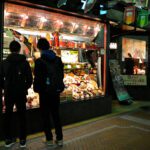
There is one element that remains weak even in restaurants with a well-designed kids menu: visibility before the order is placed. Japan solved this problem sixty years ago. Walk past any family restaurant in Tokyo and you will see the same thing — the kids menu is displayed in the window as a full-size silicone food replica, crafted so realistically that it is indistinguishable from a real dish. The child stops on the street, points, and the order is essentially decided before the family is seated. There is no menu negotiation, no ten-minute argument about what to eat, no spoiled mood for parents or kids.
The window display solves three problems at once. It lets the child choose without reading. It saves the parents the most exhausting part of the meal. And it pulls families off the street before they ever open Google Maps — converting the same passive foot traffic that walks past most restaurants every day. For restaurants outside Japan, this is the cleanest way to import the Japanese family-restaurant playbook: build a real kids menu, then display it so that no passer-by can walk past without noticing. You can see the principle applied to a full restaurant order — including two kids menu portions — in our traditional japanese cuisine replicas case.
Conclusion
A kids menu is not a kind gesture toward families — it’s a structural decision that changes the composition of who sits in the dining room, how long they stay, how often they return, and how the venue spreads by word of mouth. Ninety-five years of Japanese practice and recent Western data converge on the same conclusion: restaurants that take children seriously win the family segment, and the family segment becomes the most loyal, most pre-researched, most word-of-mouth-active customer base a restaurant can build. Any venue without a visible kids menu today is quietly handing that segment to the restaurant across the street.
Make Your Kids Menu Impossible to Miss
Nippon Dom produces realistic, hand-crafted food replicas in Tokyo for restaurants worldwide. Show your kids menu the way Japanese family restaurants do — in the window, in full size, in detail. See kids menu replicas pricing or send us your menu for a custom quote.
Button: Order custom kids menu replicas → /contact/

Related Posts

Airport Restaurant Marketing: Visual Display Ideas That Reduce the Language Barrier
