
Most restaurant window decoration ideas you find online are about props — fairy lights, plants, chalkboards, seasonal wreaths. That’s the easy part. The harder question is which decor actually stops pedestrians and which just fills the glass. Two restaurants on the same street, with similar menus and similar prices, can have wildly different foot traffic — and the difference is almost never in the kitchen. It’s in the window. This guide breaks down the seven types of decor that working restaurant windows are built from, the psychology behind why each one works, and how to combine them so that your storefront turns passersby into paying guests.

Окно в три секунды: как мозг прохожего принимает решение
The human brain processes visual information in nanoseconds. Long before a pedestrian consciously thinks about lunch, their visual cortex has already scanned your storefront, classified it, and made a preliminary decision: walk on, slow down, or stop. Retail researchers consistently put this window at one to three seconds. That’s all you have. Everything else — your reviews, your menu, your interior — only matters if the brain decides to give you those first three seconds of attention.
Именно поэтому идеи оформления витрины ресторана — это не вопрос вкуса или эстетики. Это вопрос инженерии. Работающая витрина действует как беззвучный продавец, сообщая о кухне, ценовом диапазоне, атмосфере и качестве — без единого произнесённого слова. Рестораны, которые понимают это, проектируют свои витрины исходя из того, как мозг работает на самом деле, а не из того, как владельцу хочется, чтобы он работал.
Why “Empty” Windows Lose Money Even with a Great Menu
An empty or sparsely decorated window sends a signal the owner never intended. The brain reads emptiness as absence of value. The pedestrian doesn’t think “this restaurant has a minimalist aesthetic” — they think “there’s nothing here for me,” or worse, “this place is overpriced and intimidating.” Even when the menu inside is excellent, an underdressed window creates a barrier between the street and the door.

The opposite is also true. A window dense with appetizing food samples and thoughtful decor reads as abundance, success, and confidence. This is social proof applied to architecture: if the restaurant is willing to invest in showing off what it serves, it’s likely worth walking in. A well-designed дизайн витрины ресторана is not just decoration — it’s a credibility signal that justifies the price on the menu before the guest ever sees it.
Семь типов декораций витрины ресторана: рабочий словарь
Before we look at how decor influences the pedestrian brain, it helps to know what kinds of decor we’re actually talking about. Restaurant decor isn’t one category — it’s seven, and most working windows combine three or four at the same time. Owners who can name each type can also plan rotation, budget, and visual hierarchy with much more precision.
1. Сезонные декорации. Привязаны к календарному сезону — сакура и тюльпаны весной, пальмовые листья и подсолнухи летом, кленовые листья и тыквы осенью, ель и снег зимой. Главный инструмент против привыкания прохожих.
2. Праздничные и событийные декорации. Tied to specific dates — Christmas, New Year, Halloween, Valentine’s Day, Easter, Mother’s Day, Father’s Day, Thanksgiving, local national holidays. Creates urgency the way “limited time” creates urgency in advertising.
3. Тематические и стилевые декорации. Отражают концепцию заведения вне привязки к календарю. У каждой кухни и формата — свой визуальный словарь:
- Ресторан в аэропорту: модели самолётов, глобусы, флаги стран, графика табло вылетов, винтажные туристические плакаты.
- Японский ресторан или суши-бар: бумажные фонарики тётин, веера, куклы кокэси, гравюры укиё-э, бамбук, тканевые занавески норэн. Больше примеров того, как тематический реквизит сочетается с муляжами блюд, — в галерее наших витрин азиатских ресторанов по ссылке.
- Итальянская пиццерия: винтажные итальянские дорожные знаки, гирлянды лампочек, бутылки кьянти в соломе, клетчатые ткани, деревянные лопаты для пиццы.
- Морской или рыбный ресторан: канаты, рыболовные сети, штурвалы, фонари-маяки, стеклянные поплавки, плавник.
- Американский дайнер или ретро-кафе: хромированные элементы, музыкальный автомат, виниловые пластинки, неоновые вывески, мемориальные предметы Coca-Cola.
- Тропическое кафе или тики-бар: пальмовые листья, ракушки, бамбук, гавайские гирлянды, плетёная мебель.
- Индустриальный лофт или крафтовая пивная: открытый металл, грубое дерево, кирпич, эдисоновские лампы, пивные бочки.
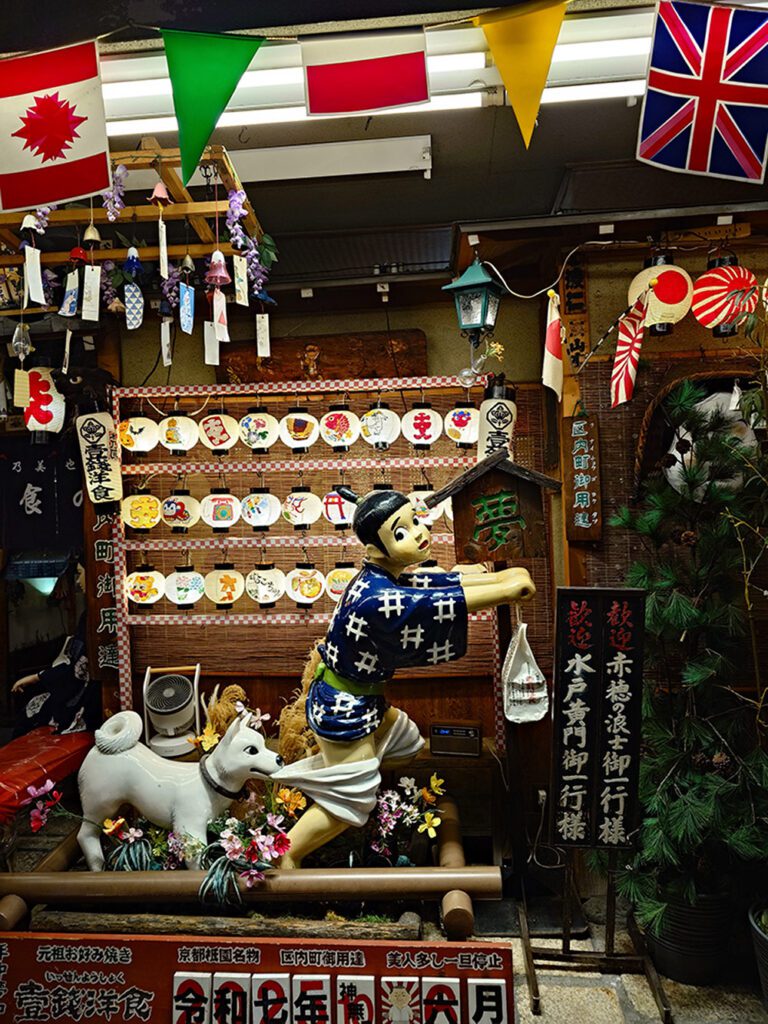
- Кафе в стиле Японии эпохи Эдо: деревянные вывески, тканевые занавески норэн. Подвесные фонарики, фестивальные флажки, расписанные вручную доски.
4. Брендированные и коллаборационные декорации. Используют узнаваемых персонажей, логотипы или бренд-коллаборации — собственный маскот, лицензионные фигуры, партнёрства с другими брендами. Добавляют эмоциональную связь и узнаваемость.
5. Промо-декорации. Highlights a specific offer, new dish, or limited edition — price tags, “new” tags, posters of dishes, POP materials. Converts attention into a concrete choice.
6. Архитектурно-композиционные декорации. Декор, который сам становится скульптурным элементом — башни, пирамиды, гирлянды, вертикальные стены, крупные инсталляции. Превращают продукт в архитектуру и останавливают прохожих издалека.
7. Фотогеничные декорации. Designed to be photographed by passersby for social media. Usually a single oversized element that breaks the scale of the street. The newest type — it didn’t exist as a design category until the smartphone era.
Оставшаяся часть статьи проходит по каждому из этих типов и показывает, что именно он делает с мозгом прохожего.
Архитектурный декор: почему в каждой витрине нужна «звезда»
Когда глазу не на чём остановиться — он скользит мимо. Витрина, заполненная одинаковыми по размеру и расстановке предметами, читается как визуальный шум — мозг не находит якорь и идёт дальше. Решает эту проблему визуальная иерархия. В каждой работающей витрине есть один доминирующий элемент — hero product. Всё остальное его поддерживает.

The masters of this principle are not always restaurants. Jean-Paul Hévin’s chocolatier boutique in Tokyo builds a two-meter tower of macarons in the center of its display. Each individual macaron is the size of a coin — but stacked into a chromatic cone, they become an architectural statement that stops pedestrians from across the plaza. A small product was made monumentally visible by composition alone. This is architectural decor at its most direct: the product itself becomes the sculpture. Browse our галерей витрин и другими примерами hero product, которые украшают всю витрину магазина.
Брендированный и тематический декор: как идентичность продаёт раньше меню
Price tags do an important job in a restaurant window — they reduce the pedestrian’s anxiety about cost and help them decide whether to step inside. But by the time a pedestrian is reading prices, the window has already won the first round. The job of bringing someone close enough to read those tags belongs to decor. Decor turns a window from an inventory display into a scene — and scenes activate the emotional brain that decides where to eat.
The identity layer of that story is carried by thematic decor (what kind of place is this?) and branded decor (who is this place a friend of?), while seasonal and holiday decor lay the pulse of time on top — we’ll come back to those in the next section. When the identity layer is strong, the pedestrian doesn’t just see a restaurant — they see a world they want to step into for the next hour.
Few brands demonstrate this better than Fujiya — a Japanese confectionery company founded in 1910 and famous since 1951 for its Milky candy and its mascot, Peko-chan. Peko-chan is a six-year-old girl with her tongue sticking out, mid-lick of a sweet; her name comes from the Japanese onomatopoeia “peko peko,” the sound of an empty stomach. Beside her stands Poko-chan, her companion mascot. Together they have been the face of the brand for more than seventy years and are instantly recognizable across generations of Japanese consumers.
In October 2021, Fujiya, the toy maker Medicom Toy, and the airline ANA released a special edition Bearbrick set: Peko-chan in an ANA cabin attendant uniform and Poko-chan in an ANA captain uniform. The logic of the collaboration is deceptively simple. ANA stands for travel, hospitality, and meticulous Japanese service. Fujiya stands for sweets given as gifts and shared on a journey. Putting Peko-chan, the most beloved childhood icon, into the uniform of the country’s most trusted airline merges two strong emotional brands into one storefront prop. The oversized Bearbrick figures in the Fujiya window are not just decoration — they are a complete identity statement: nostalgic, premium, made-in-Japan, and quietly playful. Every adult walking past instantly reads the message: this is a place that combines childhood memory with grown-up quality.
Это потолок того, что может брендированный и тематический декор. У большинства ресторанов никогда не будет национального маскота или партнёра-авиакомпании — но принцип масштабируется вниз. Пиццерия может выставить винтажные итальянские дорожные знаки. Суши-бар — взять в раму гравюру укиё-э. Придорожное кафе — повесить хромированный музыкальный автомат. Каждый предмет делает ту же работу, что Пэко-тян у Fujiya: говорит прохожему ещё до того, как он прочёл хоть одну строчку меню — для кого этот ресторан.

Сезонный и праздничный декор: триггер, который побеждает привыкание
The single biggest enemy of any window display is habituation. After a few days, the regular commuter’s brain files your storefront as “background noise” and stops registering it. The visual cortex is built to flag novelty, not familiarity. If your window looks the same on Monday and Friday, it has effectively become invisible to the people who walk past it every day — your most valuable potential customers.
Решение — ротация, и две самые дешёвые её формы — это сезонный и праздничный декор. Сезонный декор меняется с календарным сезоном: осенние листья вокруг горшочка шабу-шабу, снежинки и еловые ветки рядом с зимними десертами, cherry blossoms with spring drinks. Holiday decor pegs to specific dates — Christmas, Valentine’s Day, Halloween, Easter, Thanksgiving. Together they give a restaurant ten to twelve natural reasons per year to refresh the window, each one creating a new wave of attention from people who had stopped noticing.

There is a second effect that owners often underestimate. Fresh seasonal and holiday decor doesn’t only fight habituation — it lifts the pedestrian’s mood. The brain treats a wreath in December or fresh autumn leaves in September as a small signal that time is moving, that life is happening, that something is coming. A person in a lifted mood is significantly more likely to step into a restaurant. The decor is doing emotional work before the food has a chance to.
Японская розница довела этот принцип до искусства. Он называется кисэцу-о сакидори — “anticipating the season.” Decor appears slightly before the season actually arrives. The pedestrian who sees autumn leaves in early September registers a fresh signal: the season has shifted, and so should my appetite. By the time autumn is in full swing, competitors are putting up their leaves while yours have already been creating cravings for two weeks. Holiday decor works the same way: pine and snowflakes before December, hearts before mid-February, jack-o’-lanterns before late October.

Фотогеничный декор: когда витрина становится бесплатной рекламой
A modern window display has a second job that didn’t exist twenty years ago: it has to be photographable. Every pedestrian who stops to take a picture and post it to Instagram, TikTok, or Google Maps becomes a unilateral marketing channel for your restaurant. Japanese retailers have a word for this kind of design — эйбаэру, meaning “looks great in a photo.” It is now a design requirement, not a bonus.
Самый сильный фотогеничный декор ломает масштаб обыденной уличной среды одним крупным элементом. Фигура самурая в натуральную величину у входа в лапшичную. Гигантский маскот у десертного кафе. Стена из двухсот светящихся фонариков. Эти элементы превращают прохожих в фотографов, а фотографии — в бесплатную рекламу, распределённую по социальному графу каждого, кто остановился. Ресторан, который проектирует витрину «под камеру», превращает свой фасад из статического актива в самовоспроизводящийся. Фотогеничный декор часто пересекается с тематическим — самурай у входа выполняет обе функции — но проектный замысел другой: каждое решение оценивается по тому, вызывает ли оно у прохожего рефлекс достать телефон.
Промо-декор и муляжи блюд: основа оформления витрины
Of the seven types of decor, promotional decor is the one that converts attention into a transaction. A price tag beside a dish, a “new” flag, a poster of the season’s special — these tell the pedestrian not just what the restaurant serves but what to choose. And every restaurant window decoration idea above — first impression, hero product, branded identity, seasonality, photo-op — depends on one prerequisite: the food in the window must look fresh and appetizing at all times. Real food cannot do this. A real bowl of ramen wilts in an hour. A real parfait melts in twenty minutes. A real steak browns and dries by lunch. The window stops working the moment the food in it stops looking edible.
Именно это — структурная причина, по которой японские силиконовые муляжи блюд became the foundation of restaurant window design across the world. A precision replica preserves the hero product indefinitely. It lets you combine promotional tags, seasonal decor, and branded elements around a permanent core without worrying about waste. It works in direct sunlight, behind glass, in cold or heat. And because it shows the exact portion and the exact price next to it, it removes the unspoken anxiety pedestrians feel about entering a restaurant where they don’t know what they’ll get or what it will cost.
Витрина без муляжей может опираться на фотографии, вывески и реквизит. Ни одно из этого не активирует аппетит так, как трёхмерное блюдо в натуральную величину с гиперреалистичной отделкой. Мозг реагирует на объёмную еду на уровне, недоступном плоским изображениям — это сенсорный маркетинг, применённый к архитектуре. Посмотрите наше портфолио — примеры того, как муляжи превращают стеклянные панели в инструменты конверсии.
Ваша витрина — самый рентабельный маркетинговый актив, который у вас есть
A restaurant window works twelve or more hours a day. It doesn’t take a salary. It doesn’t take a vacation. It doesn’t require a marketing agency to update it. And it speaks to every single pedestrian who passes by — a volume of impressions that paid advertising rarely matches.
Лучшие идеи оформления витрины ресторана — это вообще не про оформление. Это инженерия поведения прохожего. Витрина, которая уважает трёхсекундное окно решения, осознанно сочетает все семь типов декора, удерживает взгляд hero product'ом, рассказывает связную историю идентичности, обновляется вместе с сезоном и работает «на камеру» — будет тихо обыгрывать любой другой маркетинговый канал ресторана. Инвестиция — доля того, что большинство ресторанов тратит на один месяц цифровой рекламы. И она работает годами.
Готовы превратить ваш фасад в беззвучного продавца?
Закажите муляжи блюд, созданные мастерами Токио — они станут якорем вашей витрины, сохранят внешний вид годами и окупят инвестицию одним приростом трафика.

Похожие посты

Ценники к муляжам блюд: почему они обязательны в витрине и как оформить их правильно

Изобильная витрина: почему полная витрина продаёт больше — и где обилие превращается в хаос

Освещение витрины ресторана: гид от японского эксперта

Идеи детского меню для кафе и семейных ресторанов

Идеи оформления витрины посуды: как увеличить продажи в магазине

Психология цен в ресторане: как цифры влияют на продажи

Сила цвета в ресторане: как цвета влияют на клиентов и продажи
