
Some restaurateurs never stop to realise they own the most valuable advertising space in the neighbourhood — so they never use it to their advantage. That space is the window of their own restaurant. It comes with the place: whether it is part of the lease or the property you bought, you pay for it every month regardless. Whether it works for your sales or not, its cost does not change — but its value does. Thousands of people walk past it every day, let their eyes slide across it, and decide — based on how it is arranged — whether to come in or keep walking. The window is the cheapest and at the same time the most powerful billboard you will ever have. The only question is what you put on it.
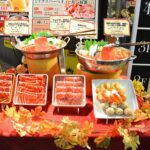
This article is about a properly arranged abundant food display — a full restaurant window that signals what the kitchen is capable of and draws people inside. We are talking about a window dressed with food replicas — realistic, life-sized models of your dishes that stand in for real food and never spoil. If you have decided to dress your window with replicas, we will cover how to do it right: why a full window outsells an empty one, where exactly abundance turns into chaos, and which century-old Japanese rules let you feel that line.

Why Restaurants Are Afraid to Fill the Window — and Why They Shouldn’t Be
Some restaurateurs are afraid to make the window too full. They feel that a large number of dishes creates chaos, overloads the space, and looks “cheap.” So windows are often arranged minimally: a few dishes, a lot of empty space, a tidy composition. The problem is that a restaurant is not a clothing boutique or an electronics store. People do not come to a restaurant for minimalism. They come for food.
Japanese restaurant marketing noticed the pattern long ago: an empty window reads as limited choice, while an abundant one reads as a place where there is something to order. This is exactly why restaurant windows in Japan are often filled with dozens of food replicas — realistic, life-sized models of the dishes.
When a person walks past a restaurant, they have no time to read the concept of the place. In a few seconds, the window has to answer three questions:
- What do they serve here?
- Is there much choice?
- Do I want to eat this?
An abundant window answers all three instantly.
Why a Large Number of Dishes Works
A large number of dishes creates the impression of an active, in-demand restaurant. A full window is read as a sign of popularity and variety. This works especially well in tourist areas, food courts, near stations and in airports, where decisions are made fast.
An abundant window also reduces the fear of an unfamiliar cuisine. When a person sees many dishes, they grasp the restaurant’s range, portion sizes, ingredients and plating style more quickly. This matters most for foreigners and travellers, who rely almost entirely on what they can see rather than on a menu they cannot read.

There is one more important point: a full window holds the gaze. A few dishes are read in a second, and the person moves on. But when the window is full, the eye begins to “travel” across it. This is what researchers call visual hunger — the appetite response set off by the sight of food, and the more appetising signals are present at once, the harder it is to look away. The viewer studies details, compares dishes, looks for the most tempting one. The longer a person stands in front of the window, the higher the chance they will come in.
Where Abundance Ends and Chaos Begins
The mistake many restaurants make is simply placing as many dishes as possible with no structure. Abundance works only when the window is organised — and there is hard evidence for where the limit lies.
In a well-known study by psychologists Sheena Iyengar and Mark Lepper, published in 2000, a grocery store tasting booth offered either 24 jams or just 6. The larger display drew far more attention — it was approached about 150% more often — but only 3% of the people who saw it bought anything, against 30% at the smaller table. Fewer options produced roughly ten times the conversion. The effect depends on context and does not appear in every setting, but the direction is consistent: past a certain point, too many options shown at once make people choose nothing at all. The brain comfortably holds only a handful of items at a time — classic research puts the working limit at about seven, give or take two. A window must respect that limit, which is why structure matters as much as quantity.
Japanese windows are almost always built on a clear set of rules:
- large dishes are placed lower, smaller dishes and desserts higher;
- the best-selling or most profitable items occupy the centre, on the “golden line” — roughly eye-to-chest height, where attention naturally concentrates;
- plates are tilted so the food faces the viewer — about 45° on lower shelves, rising to around 60° higher up;
- dishes of different heights alternate;
- many dishes of the same colour or shape are not placed next to each other.

The main task is to create a sense of rich choice without visual noise. If the viewer does not understand where to look, the window stops selling.
Why Set Menus Work So Well in a Full Window
In Japanese restaurants, the central spots are often taken by sets and combination meals. The reason is simple: they look abundant.
A single set instantly creates the impression of a complete table — a main dish, soup, rice, salad, a drink, sauces. Even one such set visually replaces several separate items and makes the window look fuller.

Sets also help raise the average check. It is psychologically easier for a guest to order a ready-made set than to assemble a meal themselves. If the window case is small but the menu is large, bringing a hero set out onto a table in front of the glass enlarges the display and meets the customer at street level.
The Mistake of Empty Space
In many modern restaurants, windows look too empty. Owners leave large gaps between dishes, trying to make the arrangement feel “more expensive.” But for a restaurant window, emptiness often works against sales.
When there is too much space between dishes, the range looks small. The window stops reading as a place with a wide choice of food.
Japanese restaurants usually use the space far more densely. But they avoid disorder through levels, proper composition and good lighting — and through one cheap trick worth borrowing: a mirrored back wall, which visually doubles the display so a modest number of dishes reads as a full, abundant case.
Light and Cleanliness Matter More Than Expensive Decor
Even the best food replicas stop working in a dirty or poorly lit window.
An abundant window requires:
- bright, warm lighting — warm, high-quality light deepens the colour of food, while cold or dim light makes everything look clinical and dead;
- clean glass;
- no dust;
- seasonal and holiday decoration
[ССЫЛКА: статья о декоре витрины — добавить, когда будет опубликована]; - tidy price tags.
In Japanese restaurants the window is seen as an extension of the kitchen. If the window looks neglected, the guest automatically transfers that feeling to the quality of the food. And quality starts with the replica itself: a cheap, glossy or badly proportioned model makes a full window look cluttered rather than abundant. A replica built to the exact size of the real dish, hand-finished down to the gloss of a sauce and the edge of a clam shell, is what every other rule depends on.

This is why the craft behind the replica matters. Nippon Dom produces custom food replicas in Japan and helps restaurants plan the full restaurant window display design — composition, grouping and lighting — so the replicas you order actually do their job. For a real example of abundance and structure working together, see our case for restaurant Trapeza.
The Main Rule of an Abundant Window
An abundant window should create one feeling: “There is a lot of good food here, and I want to try it.”
If the window produces exactly that reaction, it is arranged correctly.
A good window does not just decorate a restaurant. It stops passers-by, helps them choose a dish faster, reduces hesitation, and increases the number of visitors before a person has even opened the door.
Ready to fill your window with a display that actually sells? Nippon Dom produces custom food replicas in Japan and helps restaurants worldwide build abundant, well-structured window displays that turn passers-by into customers.

Related Posts

Food Replica Price Tags: Why Every Display Needs Them and How to Get Them Right

Restaurant Window Decoration Ideas: Seven Types of Decor That Stop Pedestrians and Bring Customers In

Restaurant Window Display Lighting: A Japanese Expert’s Guide to Making Food Look Irresistible

Kids Menu Design Ideas for Family Restaurants and Cafés

Dinnerware Marketing Ideas: How to Increase Sales in Retail Stores

Restaurant Pricing Psychology: How the Magic of Numbers Boosts Sales

